About Tuvalu
Eight standing together
“Tuvalu” means eight standing together, for the eight traditionally inhabited islands. Niulakita, the ninth, completes the nine stars on the national flag.

Where is Tuvalu?
Tuvalu is in the western Pacific Ocean, in Polynesia, roughly halfway between Hawaiʻi and Australia. Its nearest neighbours are Kiribati to the north, Fiji to the south, and Wallis and Futuna, Tokelau and Samoa to the east. The islands run in a chain about 600 kilometres long, from Nanumea in the north-west to Niulakita in the south-east.
With about 26 square kilometres of land, Tuvalu is the fourth-smallest country in the world by area, after Vatican City, Monaco and Nauru. Its ocean territory is vast by comparison: an exclusive economic zone of about 750,000 square kilometres.
The nine islands
Tuvalu has six atolls, which are rings of coral reef and islets around a lagoon, and three reef islands without a lagoon. From north to south:
- Nanumea
- Nanumanga
- Niutao
- Nui
- Vaitupu
- Nukufetau
- Funafuti
- Nukulaelae
- Niulakita
The land is low everywhere. The highest natural point, on Niulakita, is about 4.6 metres above sea level, and much of Funafuti is far lower. That is why rising seas matter so much here: see Is Tuvalu sinking?

Funafuti, the capital
Funafuti is Tuvalu’s capital and its largest atoll, home to more than half the population. Government offices, the international airport and the main port are on Fongafale, a narrow islet on the eastern side of the lagoon; the government centre is at Vaiaku. The western rim of the lagoon is protected as the Funafuti Conservation Area, about 33 square kilometres of reef, lagoon and islets.

Population and people
About 10,600 people lived in Tuvalu at the time of the 2022 census. Most Tuvaluans are Polynesian, and many families have links to more than one island. A large community of Tuvaluans also lives abroad, especially in New Zealand, Australia and Fiji.

The flag of Tuvalu
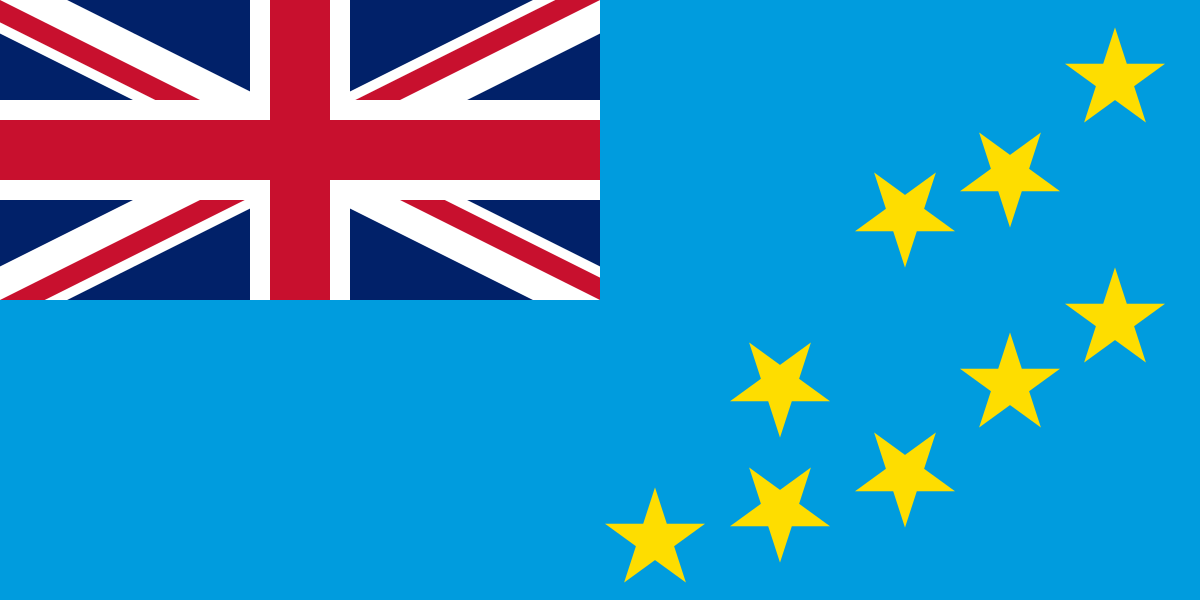
Tuvalu’s flag is light blue, with the Union Jack in the upper corner next to the flagpole and nine gold stars. The stars are placed to match the positions of the nine islands on a map, with north at the top. The flag was first raised at independence on 1 October 1978. A different design was used from 1995 to 1997, and the original was restored on 11 April 1997.
Language
Tuvaluan and English are the official languages. Tuvaluan is a Polynesian language closely related to Samoan and Tokelauan, with northern and southern dialects. On Nui, people also speak a language related to Gilbertese, the language of Kiribati. English is used in government, education and business.
Government
Tuvalu is a parliamentary democracy and a constitutional monarchy within the Commonwealth. King Charles III is Head of State, represented by the Governor-General. Parliament, the Palamene o Tuvalu, has 16 members and elects the Prime Minister from among them. Tuvalu has no formal political parties. Hon. Feleti Teo has been Prime Minister since February 2024; see the Prime Minister’s page.
On each island, the falekaupule, the traditional assembly of elders, remains at the heart of community decisions.
Economy and the .tv domain
With little land and few natural resources on it, Tuvalu earns most of its government income from the sea and from long-term investments. The main sources are licence fees paid by foreign fishing fleets working in Tuvalu’s waters, the Tuvalu Trust Fund, set up in 1987 with the United Kingdom, Australia and New Zealand, and the .tv internet domain.
The .tv domain is Tuvalu’s country-code domain. Because “tv” is also short for television, it is popular with broadcasters and streaming sites, and its licence fees are an important source of national income. Since 2021 the domain has been operated under a contract with GoDaddy. See Partner with Tuvalu.
The currency is the Australian dollar. Tuvalu also issues its own coins, which circulate at the same value.
Culture, faith and food
Tuvaluan life is built around family, church and community. The fatele, a dance-song that starts slowly and builds to a loud finish, fills the maneapa, the community meeting hall, at every celebration. Canoe-building, weaving and fishing skills are passed down through families.
Most Tuvaluans are Christian. The largest church by far is the Church of Tuvalu, a Congregationalist church.
Food comes from the sea and from the few crops that grow on coral soil: fish, coconut, breadfruit, banana and pulaka, a giant swamp taro grown in deep pits. Rising salt water in those pits is one of the most direct ways climate change reaches the dinner table.


History
Polynesian settlers reached the islands centuries before European contact. In the 19th century they became known to Europeans as the Ellice Islands, and in 1892 they became a British protectorate, later part of the Gilbert and Ellice Islands colony. In a 1974 referendum the Ellice Islanders voted to separate from the Gilberts, which are now Kiribati. Tuvalu became a separate colony in 1975 and an independent country on 1 October 1978, which is now celebrated as Independence Day. Tuvalu joined the United Nations in 2000.
Map of Tuvalu
The nine islands, from Nanumea to Niulakita
Each island is placed at its real latitude and longitude. Rings show atolls with lagoons; dots show reef islands.
Quick answers
Questions people ask
Is Tuvalu a country?
Yes. Tuvalu is an independent country in the Pacific. It became independent on 1 October 1978 and has been a member of the United Nations since 2000. It is also a member of the Commonwealth and the Pacific Islands Forum.
What is the capital of Tuvalu?
Funafuti. It is an atoll rather than a single city; most government offices are in Vaiaku on Fongafale, the largest islet of the atoll. More than half of Tuvalu’s people live on Funafuti.
What is the population of Tuvalu?
About 10,600 people, according to the 2022 census. That makes Tuvalu one of the least populous countries in the world.
Does Tuvalu have a president?
No. Tuvalu is a constitutional monarchy. King Charles III is Head of State, represented in Tuvalu by a Governor-General, and the government is led by a Prime Minister chosen by Parliament.
Do they speak English in Tuvalu?
Yes. English is an official language alongside Tuvaluan and is used in government, schools and business. Tuvaluan is the language of daily life.
What was Tuvalu called before?
The Ellice Islands. They were part of the British colony of the Gilbert and Ellice Islands until 1975 and became independent as Tuvalu in 1978.
What currency does Tuvalu use?
The Australian dollar. Tuvalu also issues its own coins, the Tuvaluan dollar, which circulate at the same value as the Australian dollar.
Is Tuvalu a rich or poor country?
Tuvalu has a small economy with few natural resources on land. Government income comes mainly from fishing licences in its large ocean territory, returns from the Tuvalu Trust Fund and the .tv internet domain, alongside support from development partners.